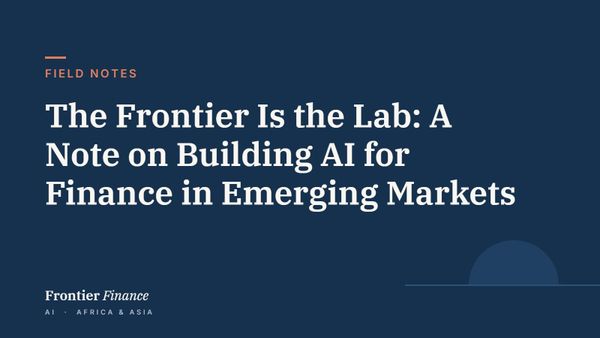
What Building an AI Financial Analyst Taught Me About Thin-Data Markets

Most AI-in-finance tools are built on an assumption that quietly breaks the moment you cross into an emerging market: that the data is there.
There is a particular kind of confidence you can only have if you have never built for an emerging market.
It shows up in the way AI finance tools are designed in San Francisco or London. Feed the model a company's filings, its credit history, its audited statements, three years of clean monthly accounts and let it reason! The architecture assumes a world thick with data: structured, standardized, abundant, and mostly true. In that world, the hard problem is analysis. The information already exists; you just need a smart enough system to interpret it.
I work on an AI financial analyst built for a different world ; one where African SMEs and the investors trying to reach them meet. And the first thing that world teaches you is that the analysis was never the hard part. The data is. Not because the people here are less sophisticated , often the opposite , but because the infrastructure of recorded financial truth that wealthy markets take for granted simply isn't there in the same form. Building AI that's useful in any anyway has been the real education, and it's changed how I think the technology should work everywhere.
Here is what thin data actually does to you, and what I've learned to do about it.
The data isn't missing — it's somewhere else
The first instinct, when you notice the gaps, is to call the data "missing." That framing is wrong, and it leads you to build the wrong thing.
A small business that has operated profitably for a decade is not data-poor. It has a rich, detailed financial reality. What it often lacks is that reality rendered in the format AI tools expect — audited statements, a clean general ledger, a credit bureau file. The information lives in mobile-money transaction histories, in supplier relationships, in a notebook, in the founder's head, in the rhythm of a business the owner understands intimately but has never had reason to formalize.
If you build an AI tool that simply demands the standard inputs and fails gracefully when they're absent, you have built something useless to most of the market. The harder, more valuable design problem is meeting the data where it actually lives and that means an AI system that can work with the unstructured, the partial, and the informal, rather than one that politely requires everything to be clean first.
Confidence is a liability when inputs are weak
In a data-rich environment, a confident answer is usually a good thing. The inputs are reliable, so a decisive output is warranted. Port that same confidence into a thin-data setting and it becomes dangerous.
When an AI tool produces a crisp valuation or a clean credit assessment from thin, partial, or self-reported inputs, it is laundering uncertainty into false precision. The number looks as authoritative as one built on audited accounts. It isn't. And the user ,an investor deciding where to put capital, or an SME deciding what terms to accept and can't see the difference unless the tool tells them.
So the most important thing I've learned to build in is not intelligence. It's calibrated humility. The system has to know how much it knows. It has to flag when an output rests on shaky inputs, surface its assumptions instead of burying them, and distinguish between "this is well-supported" and "this is my best guess from limited information." In thin-data markets, an AI that says "I'm not sure, and here's why" is worth more than one that's confidently wrong and confidently wrong is the default failure mode of systems trained on abundance.
The human isn't a fallback — they're the design
In rich-data finance, automation aspires to remove the human. The dream is the fully autonomous system: data in, decision out, no person required. The human is treated as a cost to be engineered away.
Thin-data markets invert this. Here, the local human ; the analyst who knows the sector, the relationship manager who knows the founder, the investor who understands the regional context holds exactly the information that the data doesn't capture. They're not a fallback for when the AI fails. They're the source of the very context that makes the AI's output trustworthy.
This reframes the whole architecture. The most effective design I've found isn't AI-instead-of-human or human-checking-AI. It's a genuine division of labor: the AI handles scale, structure, consistency, and the tireless processing of messy inputs into something legible; the human supplies judgment, context, and the local knowledge that no dataset contains. The AI makes the human faster, efficient and more consistent. The human makes the AI trustworthy and grounded. Neither works as well alone and in a thin-data market, "AI alone" doesn't really work at all.
Why this matters beyond Africa and Asia
It would be easy to file all this under "special considerations for emerging markets" a footnote to the real work happening elsewhere. I think that's exactly backwards.
The thin-data discipline meeting data where it lives, building calibrated humility into outputs, designing humans in as a source of truth rather than a safety net — produces better AI systems everywhere. Rich-data markets are not as data-rich as they pretend. Private companies, new ventures, novel situations, and fast-moving conditions create thin-data pockets in every economy. A system built to be honest about uncertainty and to collaborate with human judgment is more robust in London than one built on the fragile assumption that the inputs are always clean and complete.
Building for the frontier doesn't mean building a lesser version of the "real" thing. It means confronting problems the well-resourced markets have been able to paper over with abundance and solving them produces tools that are, in the ways that matter, better.
The most interesting AI-in-finance problems aren't in the places with the most data. They're in the places with the least. That's where you're forced to build systems that are honest about what they don't know, humble about their limits, and designed to work with people rather than around them. Those, it turns out, are the systems worth building anywhere.
Frontier Finance AI covers the collision of artificial intelligence and capital markets across Africa and Asia. This piece reflects the author's personal views and general lessons, not the specifics of any employer or product.